


Fiber Laser Basics: Working Principles & Industrial Applications
Comprehensive Guide to Fiber Laser Basics, Principles, and Applications
In modern metal processing and industrial manufacturing, Fiber Laser technology has rapidly replaced conventional CO2 lasers and plasma cutting systems due to its superior precision, speed, and energy efficiency. Understanding fiber laser basics helps engineers and manufacturers optimize machine operations and select the right equipment for their production lines.
What is a Fiber Laser?
A fiber laser is a type of solid-state laser where the active gain medium is an optical fiber doped with rare-earth elements such as Ytterbium (Yb3+), Erbium (Er3+), or Neodymium (Nd3+). Unlike gas-based lasers, fiber lasers generate and transmit the laser beam entirely within optical fibers, eliminating the need for complex internal mirrors.
Core Working Principles of Fiber Laser
The operational mechanism of a fiber laser involves four main stages:
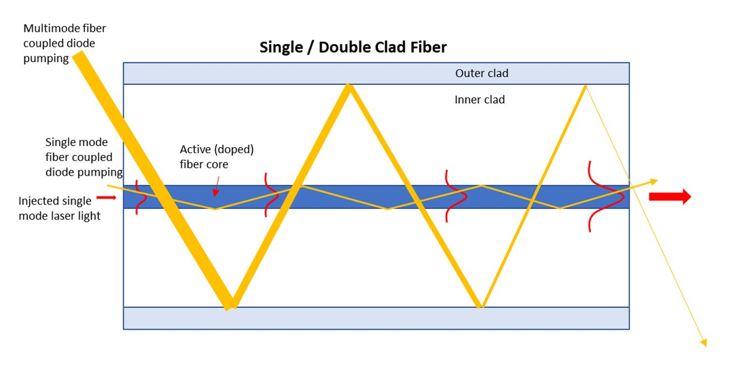
- Optical Pumping: Semiconductor pump diodes emit light into the cladding of the optical fiber.
- Gain Medium Activation: The light energy excites the doped rare-earth ions inside the fiber core, causing them to release photons.
- Signal Amplification: Fiber Bragg Gratings (FBG) act as integrated mirrors inside the fiber, reflecting and amplifying the light repeatedly to increase beam intensity.
- Beam Delivery: The resulting high-density laser beam (typically with a wavelength around 1,064 nm) is guided directly through a flexible fiber optic cable to the cutting or welding head without power loss.
For in-depth technical architecture and system design details, you can refer to Laser Lab Source: Fiber Laser Basics and Design Principles.
Spontaneous Emission
When an atom absorbs energy from an external source, electrons in their normal energy level—known as the ground state—become excited and jump to a higher energy level called the excited state. However, electrons in the excited state are inherently unstable. As a result, they naturally drop back to the ground state, releasing energy equivalent to the difference between the excited state and ground state levels. The energy released during this process takes the form of photons or light—a process known as Spontaneous Emission.

Stimulated Emission
Light emitted through spontaneous emission collides with other atoms currently in an unstable excited state. This collision triggers the electrons to release energy in the form of light photons as they drop back to the ground state. This process repeats continuously across a vast number of excited-state atoms. The emitted photons travel in the exact same direction, share the same frequency, and remain perfectly in phase—a quantum process known as Stimulated Emission.

Population Inversion
The primary requirement for laser generation is maintaining a high concentration of electrons in the excited state to sustain efficient stimulated emission. To achieve this, pump laser diodes continuously excite ground-state electrons up to the excited state. When the population of electrons in the excited state significantly outnumbers those in the ground state, the system achieves a state known as Population Inversion.

Laser Amplification
Laser amplification occurs once a state of population inversion is established. When a large number of electrons in the excited state are ready to release energy, stimulated emission is triggered across the electrons. The resulting photons travel in the exact same direction, share the same frequency, and remain perfectly in phase. This coherent light wave interaction produces laser amplification, creating a highly concentrated, high-intensity energy beam.

How a Fiber Laser Works: Working Principle & System Architecture

Fiber Laser Technology Overview
A Fiber Laser utilizes an optical fiber core doped with rare-earth elements as the gain medium to amplify laser energy. Pump Laser Diodes deliver energy to excite the electrons in the doped fiber from the ground state to a higher excited state. Within the system, Laser Combiners aggregate the power from multiple Laser Diodes, while Fiber Bragg Gratings (FBGs) act as integrated mirrors—reflecting either all or part of the light energy. This continuous back-and-forth reflection forces as many electrons as possible into the excited state to maximize power output.
Doped Fiber
A specialized optical fiber doped with rare-earth elements, with Ytterbium (Yb) being the most widely used element in fiber laser applications. Ytterbium efficiently absorbs pump energy at wavelengths of 900–1,000 nm and emits laser light at wavelengths between 1,000–1,100 nm—a wavelength range that is highly absorbed by most industrial metals.
Double-Clad Fiber
Most fiber laser systems incorporate double-clad fiber structures. This dual-layer cladding design significantly improves pump light coupling efficiency, allowing the system to convert input energy into maximum output power.
Pump Laser Diodes
Converts electrical energy into laser light to excite the electrons of Ytterbium (Yb) into the highest possible excited state. Multiple diodes are combined to scale up total energy output. Pump diodes operating at wavelengths between 900–1,000 nm are commonly used as they offer high cost-effectiveness and fall directly within the optimal absorption spectrum of Ytterbium (Yb).
Pump Laser Combiners
Combines and merges all the optical energy generated from multiple Pump Laser Diodes into a single optical fiber.
Fiber Bragg Gratings (FBG)
Serves as an integrated optical filter to block or reflect specific wavelengths, functioning similarly to traditional laser mirrors. It can either reflect total energy or partially reflect energy while allowing the rest to pass through. In a fiber laser system, two Bragg Gratings are typically utilized:
-
High Reflector (HR) Grating (Input Side): Acts as a total reflector mirror to reflect 100% of the light back into the laser cavity.
-
Output Coupler (OC) Grating (Output Side): Partially reflects approximately 90% of the light energy back for further amplification while transmitting the remaining 10% out as the usable output beam.
This continuous back-and-forth reflection maximizes stimulated emission, forcing as many atoms into the excited state as possible.
Advantages of Fiber Laser Compared to CO2 Laser Systems
- Shorter Wavelength (1.06 µm vs. 10.6 µm): Reflective metals such as aluminum, brass, and copper absorb fiber laser energy significantly better. This results in substantially faster cutting speeds and cleaner edges.
- No Reflective Mirror Alignment: The laser beam travels entirely within the fiber optic cable. This eliminates the need for manual optical mirror alignment, reducing machine downtime and lowering overall maintenance costs.
FAQ: Frequently Asked Questions About Fiber Laser Basics
Q: What types of industrial metalworking machinery utilize fiber laser technology?
A: In the metal fabrication industry, fiber laser sources are integrated into several key machinery types:
• Fiber Laser Sheet Cutting Machines: For processing metal sheets, electrical enclosures, and structural parts.
• Fiber Laser Pipe/Tube Cutting Machines: For cutting, slotting, and beveling round, square, and rectangular tubes.
• H-Beam & Structural Steel Laser Cutters: Designed for heavy structural steelwork and construction beams.
• Handheld & Robotic Laser Welding Machines: Delivering clean, high-speed welds with minimal heat distortion.
• Laser Cleaning Machines: Used for rust removal, surface preparation, and oil degreasing.
• Laser Marking Machines: For engraving barcodes, serial numbers, and logos directly onto metal components.
Q: How does a fiber laser differ from a traditional CO2 laser?
A: Fiber lasers deliver light via flexible fiber cables rather than gas-filled chambers and optical mirrors. With a wavelength approximately 10 times shorter than CO2 lasers (1.06 µm vs. 10.6 µm), fiber lasers cut thin-to-medium sheet metals much faster, consume significantly less power, and require far less optical maintenance.
Q: Why are fiber lasers better suited for cutting reflective metals like copper and brass?
A: Non-ferrous reflective metals absorb short-wavelength laser light far more efficiently. The 1.06 µm wavelength of fiber lasers minimizes back-reflection, protecting the cutting head while ensuring smooth, clean edge quality on materials such as copper, brass, and aluminum.
Q: Why choose Thermal Mechanics for fiber laser machinery solutions?
A: Thermal Mechanics is an authorized direct partner with extensive field expertise in industrial laser systems. We offer comprehensive solutions including technical consultation, equipment installation, operational training, and local spare parts support to ensure maximum uptime for your production facility.
Source: Laser Lab Source – Fiber Laser Basics and Design Principles