


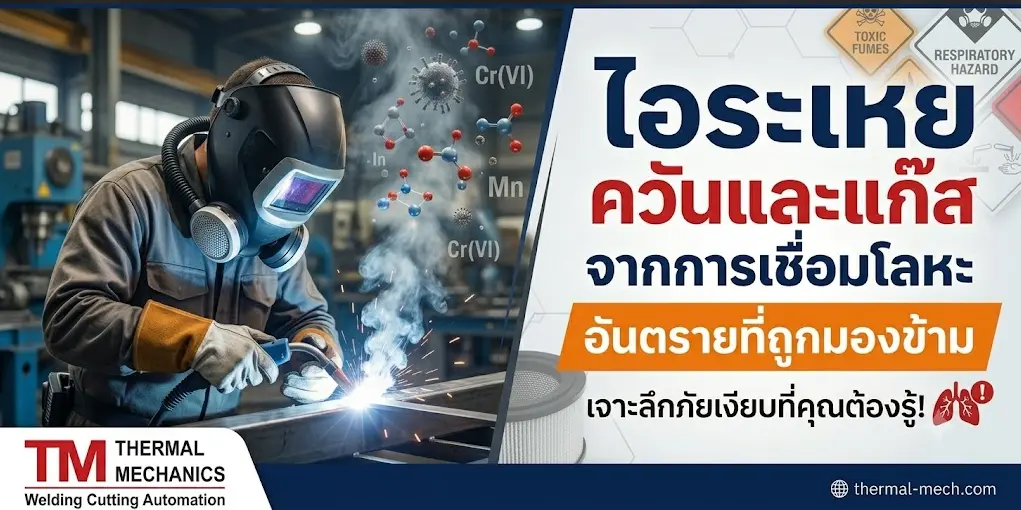
♦ Welding Fumes, Smoke, and Gases: The Overlooked Hazards
Compiled by Chatchai Innumat
Industrial Safety Guide: Management and Prevention of Hazards from Welding Fumes, Smoke, and Gases
Understanding the Silent Threat in the Workplace: What are Welding Fumes and Gases?
In steel fabrication and structural assembly, welding is a fundamental and vital process. However, a major byproduct that poses a severe threat to personnel health is welding fumes, smoke, and gases. These contaminants are formed when welding electrodes, flux coverings, and base metals melt at extremely high temperatures, reacting with the surrounding air. This process releases invisible, micron-sized metallic particles and toxic gases. Without proper engineering controls, these pollutants disperse into the atmosphere and accumulate directly in the welder’s respiratory system.
Currently, welding plays a crucial role across various manufacturing sectors. A single product may require the assembly of tens or hundreds of individual metal components. Without welding, production costs would skyrocket significantly. It has been noted that the cars we drive today could cost many times more if welding processes were not utilized.
However, whenever welding takes place, smoke is invariably generated. Have you ever considered that this smoke is a hazardous agent capable of causing a slow, unnoticed death? Welders working on specific applications—such as stainless steel, galvanized steel, or coated workpieces—face an exceptionally high risk of developing severe, life-threatening occupational diseases.
During welding, fumes are created as metals are heated to their melting points, causing vaporization. As these vapors condense, they form extremely fine solid particles measuring less than 1 micron (0.001 mm) in diameter. These emissions consist of two parts: visible fumes, which appear as a plume of smoke composed of metal oxides, and invisible vapors consisting of toxic gases. These gases originate either from the shielding gas used or from the thermal decomposition of the flux.
Both forms of emissions pose substantial risks. Driven by heat, the smoke and fumes rise upward, allowing fine particulate matter to remain suspended in the air around the welding zone. These microscopic particles easily enter the operator’s respiratory tract if adequate personal protective equipment and engineering systems are not provided.
How Do Fumes Differ Across Welding Processes?
The volume and composition of welding fumes vary greatly depending on the specific welding method utilized. Operators and HSE officers should be aware of the following distinctions:
- Shielded Metal Arc Welding (SMAW/MMA): Generates high fume volumes due to the decomposition of the electrode’s flux coating, particularly when welding high-alloy steels.
- Gas Metal Arc Welding (GIG/MAG / GMAW): Fume levels depend heavily on the shielding gas used. Mixing CO2 increases the risk of carbon monoxide exposure compared to using pure inert gases.
- Gas Tungsten Arc Welding (TIG / GTAW): Generally produces fewer metal fumes but carries a higher risk of ozone generation caused by intense UV radiation interacting with the air.
- Flux-Cored Arc Welding (FCAW) and Submerged Arc Welding (SAW): Generate flux dust and silicon dioxide, which can lead to silicosis after prolonged, unprotected exposure.
Toxic Components and Their Effects on the Human Body
Looking closely at the chemical makeup of welding fumes and gases, the hazards can be categorized into two primary groups, impacting health over both short and long horizons:
- Solid Particulates and Metal Fumes: Composed of various heavy metal dusts, including chromium, manganese, nickel, and zinc. Inhaling large quantities can trigger metal fume fever and fatigue. Over the long term, it can lead to central nervous system damage or carcinogenic effects.
- Toxic Gases from Arcing and Heat: The intense heat generates hazardous gases such as ozone (from UV radiation reactions), carbon monoxide (from incomplete combustion), and nitrogen dioxide. These gases severely irritate the respiratory tract, causing throat irritation, chest tightness, and pulmonary inflammation.
Factors Influencing Severity
The level of hazard depends on:
- The welding process utilized (e.g., Flux-Cored or Stick welding).
- The type of filler metal or welding electrode.
- Surface coatings, paints, or residual oils and grease on the workpiece.
- The efficiency of the workspace ventilation system.
- The type of base metal being welded. For instance, welding stainless steel generates chromium and nickel fumes, which are known causes of asthma and cancer. Hexavalent chromium can specifically cause nasal septal perforations and sinus issues, while manganese found in carbon steel can lead to Parkinson’s-like neurological symptoms over time.
Short-Term Effects: High exposure over a short period can result in:
- Metal Fume Fever: Occurs primarily from overexposure to zinc oxide fumes. Symptoms mimic the flu—including fever, chills, sore throat, thirst, muscle aches, fatigue, nausea, and vomiting—typically manifesting several hours after exposure. Symptoms usually subside within 1 to 3 days without permanent damage.
- Ozone Overexposure: Highly prevalent in MIG, plasma, and especially TIG welding. Inhaling excessive ozone causes severe nasal discharge, headaches, lethargy, eye irritation, and respiratory tract inflammation. Severe cases can lead to pulmonary congestion or fluid accumulation, though onset may be delayed.
- Nitrogen Oxide Overexposure: Includes nitric oxide and nitrogen dioxide generated by the electric arc. Exposure irritates the lungs similarly to ozone. Symptoms are often delayed, potentially leading to pulmonary edema (fluid in the lungs) hours after exposure has ceased.
In addition to nitrogen oxides, welding produces several other hazardous gases:
- Carbon Dioxide (CO2): Commonly used in MIG welding. It becomes highly dangerous in confined or poorly ventilated spaces by displacing oxygen, which can cause sudden unconsciousness.
- Carbon Monoxide (CO): Formed during MIG welding shielding gas reactions. In poorly ventilated areas, high accumulation leads to drowsiness, headaches, vomiting, and loss of consciousness.
- Phosgene: A highly toxic gas. It is not directly produced by the weld arc itself, but occurs when ultraviolet (UV) radiation reacts with chlorinated solvent vapors (such as trichloroethylene or perchloroethylene) located near the welding area. Prolonged exposure causes severe respiratory tract damage and pulmonary injury.
- Long-Term Chronic Effects: Chronic, long-term exposure to welding fumes can lead to:
- Respiratory System: Chronic inflammation and respiratory tract irritation, with damage often exceeding that caused by heavy smoking.
- Nervous System: Neurological damage resulting from excessive exposure to lead or manganese fumes.
- Cardiovascular System: Carbon monoxide from MIG/MAG welding binds with hemoglobin, reducing the blood’s oxygen-carrying capacity and elevating the risk of heart disease.
- Skin Conditions: Dermatitis and skin ulcers caused by Hexavalent Chromium [Chromium (VI)] compounds generated during stainless steel welding.
- Cancer: Studies indicate that welders face a 30% to 40% higher risk of developing lung cancer compared to the general population due to carcinogenic agents in welding fumes.
Additional Specific Metal Hazards:
- Lead: Found in specific brass materials, alloy steels, and soldering alloys. It targets the nervous, digestive, and circulatory systems. While rare in standard welding, it is highly prevalent during the cutting or demolition of structures coated with lead-based paint, such as old ships or bridges.
- Cadmium: Often found in plated metals and certain silver brazing alloys. It poses extreme risks, causing emphysema, severe respiratory tract irritation, bronchitis, and chemical pneumonitis. A single high-dose exposure to cadmium oxide can be fatal, while chronic exposure damages the lungs and kidneys.
- Manganese: Found in alloy steels and hardfacing electrodes. It severely damages the central nervous system and respiratory tract, causing severe pneumonia, muscle control loss, and symptoms resembling Parkinson’s disease, especially in confined space operations.
- Zinc: Present in brazing alloys, brass, bronze, and galvanized steel. Welding these metals releases zinc oxide fumes, resulting in flu-like metal fume fever that typically resolves within 24–48 hours.
- Iron: Welding primarily generates iron oxide particles. Excessive, chronic inhalation leads to particles settling in the lungs, visible on X-rays as small scattered spots, a condition known as siderosis (iron pigmentation of the lungs).
- Molybdenum: Found in specific steel alloys; causes severe eye and respiratory tract irritation under high exposure.
- Cobalt: Common in high-temperature, high-strength steels. Inhaling cobalt fumes triggers shortness of breath, chronic coughing, and pulmonary inflammation.
- Vanadium: Found in specific alloy steels and electrodes. Inhalation of vanadium pentoxide (V2O5) causes chemical pneumonitis and severe irritation of the eyes, throat, and respiratory tract.
- Nickel: Found in nickel-plated metals, high-strength low-alloy electrodes, and stainless steel. It irritates the respiratory tract and is classified as a known carcinogen targeting the nasal cavities and lungs.
- Chromium: A critical element in stainless steel and hardfacing wires. Dangerous Hexavalent Chromium [Chromium (VI)] is released during stainless steel welding, causing severe respiratory tract irritation and skin ulcers. MIG welding generally produces less Chromium (VI) compared to flux-coated stick welding (SMAW).
- Fluorides: Generated during SMAW, FCAW, and SAW processes. Fluoride dust irritates the eyes and respiratory system. Prolonged accumulation can increase bone and ligament density, though clinical disorders remain rare.
- Silicon: Present in welding wires as alloys or oxides, and as silicon dioxide in submerged arc welding flux. Fine dust in flux hoppers can enter the lungs, leading to silicosis.
Reports show that welders face a 40% higher risk of lung cancer than factory management due to their working environment. A welder working an 8-hour shift without respiratory protection breathes in about half a gram of hazardous particles daily. This accumulates to 100 grams a year, and a staggering 2.5 kilograms over a 25-year career! Smoking further multiplies this risk exponentially.
The American Conference of Governmental Industrial Hygienists (ACGIH) has established that the Threshold Limit Value (TLV) for welding fumes must not exceed 5 milligrams per cubic meter (mg/m³) over an 8-hour workday or a 40-hour workweek.
To work safely, welders must avoid these fumes. While basic safety manuals advise keeping your head out of the plume, this is often impractical on the job because welders must closely monitor the weld pool. Naturally, thermal plumes rise straight up, passing directly through the operator’s breathing zone.
In many steel fabrication shops, welders attempt to protect themselves using standard cloth masks or basic dust masks. However, under close inspection, the gaps between woven cloth fibers are massive compared to microscopic, sub-micron welding particles. Consequently, these dangerous particles easily bypass standard cloth masks and enter the lungs.
Today, advanced respiratory protective equipment efficiently filters out these fumes. These systems integrate a powered air-purifying respirator (PAPR) with an auto-darkening welding helmet (as shown in Figure 1). A PAPR system offers a nominal protection factor of 50. This means if a workplace records a fume concentration of 250 mg/m³, and the ACGIH TLV limit is 5 mg/m³, the filtration system must reduce contaminants by at least 50 times (250 mg divided by 5 mg) to deliver clean air to the worker.
Engineering Control and Technology Solutions for Welding Areas
To protect worker health in compliance with occupational safety laws and ergonomics, factories must implement effective engineering controls to capture welding fumes and gases directly at the source:
- Installation of Local Exhaust Ventilation (LEV): The most effective control method. Utilizing extraction hoods or mobile welding fume extractors with flexible extraction arms positioned near the weld pool captures hazardous chemical vapors and dust before they reach the welder’s breathing zone.
- High-Efficiency Air Filtration Systems: Fume extractors should utilize HEPA filters combined with activated carbon layers to trap fine sub-micron particulates and absorb toxic, odorous gases effectively.
- General Factory Ventilation: Dilutes gas concentrations in closed buildings. This should always be combined with standard-compliant chemical respirators for individual welders.
These air purification devices feature replaceable filter elements and a motorized blower that continuously supplies clean, filtered air inside the helmet, ensuring the welder breathes safely throughout their shift.
Furthermore, these systems feature auto-darkening welding lenses. When not welding, the lens acts like standard protective eyewear for clear visibility. The moment the welding arc strikes, the lens darkens instantly to protect against harmful radiation, with adjustable shade levels to suit different welding currents.
These advanced systems protect against both respiratory hazards and harmful arc radiation. Developing a highly skilled welder requires significant time and investment. If employers fail to protect their workforce, resulting illnesses lead to production downtime, high medical costs, and time-consuming recruitment processes…
** Parkinson’s disease **
Refers to a progressive neurological disorder that occurs when specific nerve cells in the brain degrade, reducing dopamine production. This leads to tremors, muscle rigidity, difficulty walking, and impaired motor coordination.
Health, Safety, and Environment (HSE) Checklist for Welding Operations
To implement these safety measures effectively on the shop floor, safety officers and management can use the following checklist to evaluate risks and optimize ventilation:
✔ Are ambient dust and fume concentrations regularly measured and compared against ACGIH TLV standards?
✔ Is Local Exhaust Ventilation (LEV) installed close to the welding arc, ensuring extraction arms are not placed too far from the weld pool?
✔ Do welders wear certified respiratory protection (such as HEPA/Activated Carbon respirators) instead of standard cloth masks?
✔ Is general factory ventilation adequate in enclosed or semi-confined spaces to prevent carbon monoxide and carbon dioxide accumulation?
✔ Are annual health checkups, specifically respiratory function and chest X-rays, provided for all welding personnel?
✔ Are air filters replaced regularly according to the manufacturer’s recommended lifespan?
✔ Are chlorinated solvents (e.g., degreasers) stored far from the welding zone to prevent the formation of highly toxic phosgene gas?
FAQ: Frequently Asked Questions About Welding Fumes and Gases
Q: How dangerous are welding fumes?
A: Welding fumes consist of micron-sized particles that penetrate deep into the lungs and accumulate over time. This leads to chronic respiratory irritation, lung diseases, neurological disorders like Parkinson’s, and elevates lung cancer risks by 30% to 40% compared to the general public.
Q: Can a standard cloth or surgical mask protect against welding fumes?
A: No, standard masks are insufficient. The gaps between cloth fibers are much larger than sub-micron welding particles. Operators must use dedicated respirators with proper particulate and gas filters designed specifically for welding applications.
Q: Which welding processes generate the most hazardous fumes?
A: Welding stainless steel and galvanized (zinc-coated) steel releases highly toxic elements such as hexavalent chromium, nickel, and zinc oxide. These carry significantly higher respiratory and carcinogenic risks than welding standard mild steel.
Q: What is the standard TLV limit for welding fumes?
A: According to ACGIH standards, the time-weighted average (TWA) concentration must not exceed 5 mg/m³ for a standard 8-hour workday or a 40-hour workweek.
Q: What is the ideal ventilation solution for industrial welding setups?
A: Workspaces should combine source-capture Local Exhaust Ventilation (LEV) with high-efficiency PAPR helmets and robust general factory ventilation to control contaminant levels in full compliance with safety regulations.
Elevate Your Factory Safety Standards with Thermal Mechanics
If your production facility is facing issues with heavy smoke dispersion and needs to reduce workplace concentrations of welding fumes, smoke, and gases to meet environmental and occupational safety laws, Thermal Mechanics is ready to assist. We offer expert consultation, engineering design, and installation of world-class industrial fume extraction systems to secure long-term health, compliance, and production efficiency for your business.
📌 Authorized distributor of industrial metal processing machinery with comprehensive professional after-sales service.
Contact us: 📩 FB Inbox: m.me/thermalmech
✅ LINE OA: @thermalmechanics
📧 Email: sales@thermal-mech.com
☎️ Tel: 02-759-4795
References
- CCOHS – Canadian Center for Occupational Health and Safety
- NOHSC – National Occupational Health and Safety Commission (Australia)
- OSHA – Occupational Safety and Health Administration (USA)
- CDC – Centers for Disease Control and Prevention (USA)
- MMU – Environmental and Occupational Health Research, Manchester Metropolitan University
- Manganism FYI – Manganese Toxicity Information
- Yahoo Health – Metal Fume Fever Medical Data
- AWS – American Welding Society Journal (Technical Paper: “Welding Fumes and Gases”, September 2002)
- Hornel Int. (A practical guide to welding respirator protection)